Challenges for a Trombonist
by Dr. Peter Brennecke, supplemented and completed in December 2025 by Dr. Angela Brennecke and Toni Ginsel
Introduction
Throughout his musical life, Chris Barber demonstrated a rare combination of curiosity, openness, and artistic integrity. Deeply rooted in New Orleans jazz, he never allowed himself to become confined by a single idiom. Rather than drawing boundaries, he consistently sought dialogue – with fellow musicians, with emerging currents, and with sound worlds that initially lay outside his own experience.
This attitude brought him both acclaim and challenges. For a trombonist such as Barber, every encounter with a different genre required more than technical adjustment; it demanded a conscious engagement with style, musical language, and expressive intent. Three exemplary collaborations illustrate the breadth of his adaptability: his work with the London Gabrieli Brass Ensemble, with the Swiss singer-songwriter Tinu Heiniger, and with the New Orleans pianist Eddie Bo.
- Chris Barber and the London Gabrieli Brass Ensemble
The London Gabrieli Brass Ensemble was founded in 1963 by David Biddulph, Richard Hill, John Simcock, and Peter Harvey. Its name refers to Giovanni Gabrieli (1554/57–1612), the influential Venetian composer at St Mark’s Basilica and a key figure in the transition from the Renaissance to the Baroque.
The ensemble, however, did not regard itself as a guardian of early music, but rather as a sonic laboratory operating between classical and popular traditions. Its guiding principle – to bridge the gap between popular and classical music – shaped numerous tours and recordings.
The collaboration with Chris Barber is documented on the CD:
“The London Gabrieli Brass Ensemble featuring Chris Barber (Solo Trombone): Under the Influence of Jazz”
(Timeless TTD 569, May/June 1989).
Together they created the suite “Jazz Colours”, comprising eight episodes that trace the historical development of jazz in evocative sound images. The work forms part of a larger ballet suite, whose second section, the “Magnolia Suite”, is thematically related. Composer Richard Hill and Chris Barber developed the piece in close collaboration, seeking to make the theatrical and emotional potential of early jazz audible within a concert-hall context.
For Barber, this project required a delicate balancing act: between orchestral precision and improvisational freedom, between classical discipline of tone and jazz-inflected spontaneity. His trombone functioned as a bridging instrument – at times a solo voice, at others an integral component of a symphonic texture. - Chris Barber and Tinu Heiniger
Tinu Heiniger (born 1946 as Martin Heiniger) is among Switzerland’s most distinctive singer-songwriters. Since the 1970s, he has shaped Bernese dialect music with guitar, harmonica, clarinet, and tenor saxophone. His songs blend elements of folk music, chanson, and jazz, often marked by poetic acuity and social awareness.
On his CD “Läbe wie ne Chatz” (Zytglogge ZYT 4068, 1993), Chris Barber appears on two tracks:
“Some of These Days” [Note: Original text listed „Save“, likely a typo] and “Everybody Loves My Baby”.
The collaboration never took place in a shared studio. Heiniger recorded in Basel at Blackwood Recording Studio, while Barber added his trombone parts at Studio 17 in Hamburg. Despite this physical separation, the result is a remarkably coherent sonic dialogue: the warm, earthy voice of the Swiss songwriter meets the elegant, lyrical tone of a British jazz musician.
For Barber, the challenge here was a subtle one. Rather than improvising freely within a jazz framework, he had to place his playing in the service of the song’s narrative – restrained, supportive, yet unmistakably personal. The result underscores the universality of his musical language. - Chris Barber and Eddie Bo
Eddie Bo (1930–2009) was a pianist, singer, and producer from New Orleans – a pivotal figure bridging jazz, R&B, and funk. His style was defined by a driving groove, pronounced syncopation, and that distinctive blend of earthiness and elegance which characterises the New Orleans sound.
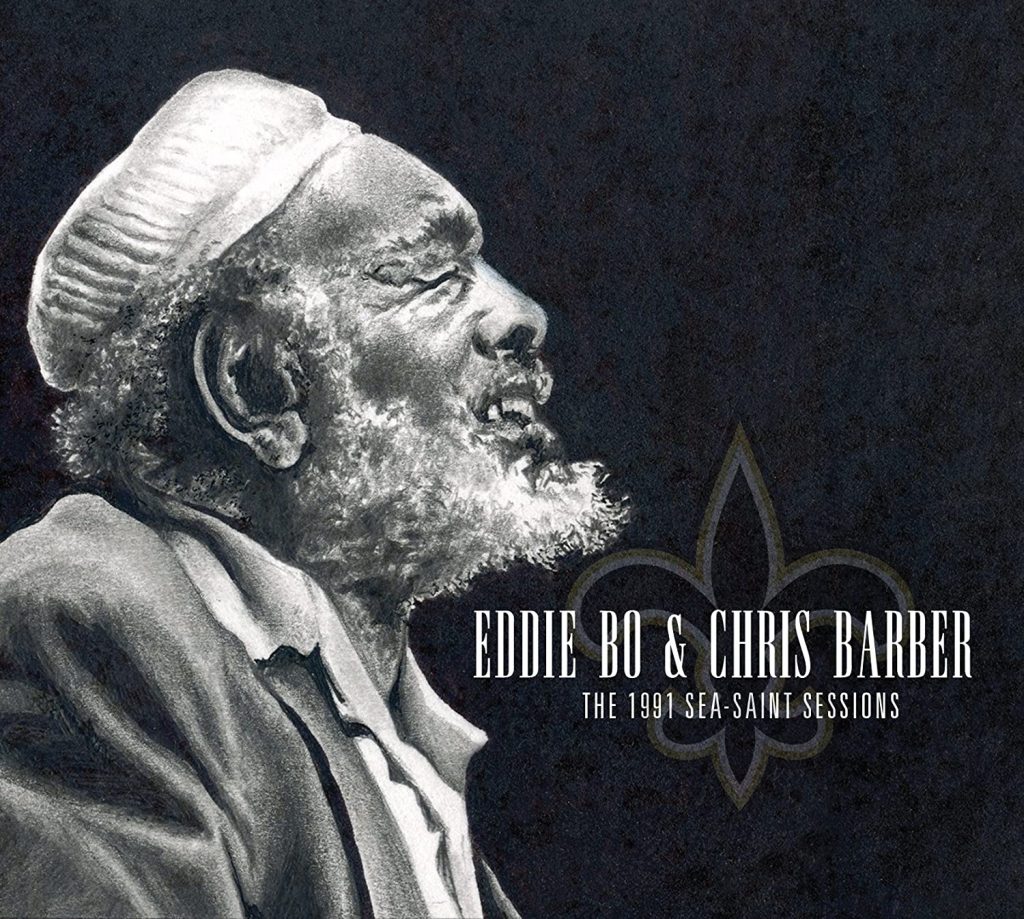
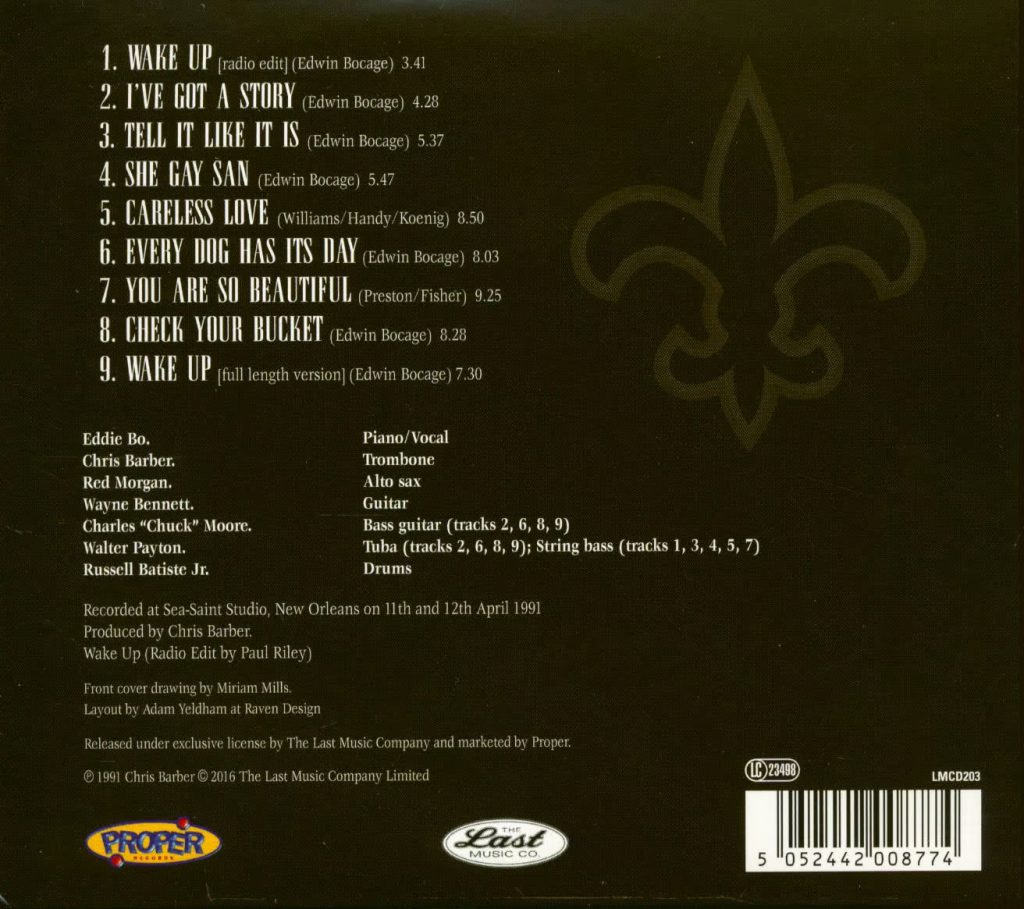
The encounter with Chris Barber took place in 1991 at the legendary Sea-Saint Studios in New Orleans during Barber’s U.S. tour. The recordings remained unreleased until 2016:
“Eddie Bo & Chris Barber – The 1991 Sea-Saint Sessions”
(Last Music Company LMCD 203, distributed by Bear Family Records).
Participating Musicians:
Eddie Bo – piano, vocals, arrangements
Chris Barber – trombone
Wayne Bennett – guitar
Walter Payton – bass
Russell Batiste Jr. – drums
“Alto Red” Morgan – saxophone
Charles “Chuck” Moore – bass (on selected tracks)
Tracklist:Wake Up
- I’ve Got a Story
- Tell It Like It Is
- She Gay San
- Careless Love
- Every Dog Has Its Day
- You Are So Beautiful
- Check Your Bucket
- Wake Up (Alternate Version)
Musical Significance
These sessions rank among the most compelling moments of Barber’s later career. British jazz and American funk meet here on equal footing.
For Barber, this was no routine engagement, but a genuine stylistic stress test:
• He had to translate his flowing swing legato into tightly articulated, syncopated lines.
• The trombone functions less as a solo instrument and more as part of the rhythmic framework.
• Sonically, the context required greater attack, stronger grounding, and a reduction of tonal polish.
The music breathes the spirit of New Orleans, yet Barber’s musical identity remains unmistakable. The “Sea-Saint Sessions” reveal him as a musician willing to learn, approaching an unfamiliar idiom without vanity and animating it from within.
Conclusion
What distinguished Chris Barber as a trombonist was not virtuosity alone, but his exceptional musical mobility. He was able to enter new sonic environments without ever disavowing his roots.
In orchestral settings, he sought colour.
In the singer-songwriter context, he sought sensitivity to text.
In the funk idiom of New Orleans, he sought grounding and groove.
The result is the portrait of a musician who did not merely preserve jazz, but allowed it to breathe across stylistic boundaries. Chris Barber was not a musical border-crosser by design, but by curiosity – and it is precisely this curiosity that continues to animate his legacy.